The history of the Old Towne Preservation Association
Rob Boice on how OTPA began and why the Mills Act matters.
Plain-language updates on the property tax program for historic homes, and on the citywide Historic Preservation Ordinance, now approved on first reading by the City of Orange.
Kept by Justin Ladd, Historic Homes Orange County
Email updates on the Mills Act, Orange’s preservation ordinance, City meeting dates and new interviews.
A California law passed in 1972 that lets cities give owners of qualified historic properties a property tax reduction in exchange for a long-term promise to preserve and maintain the building.
“The Mills Act is the single most important economic incentive program in California for the restoration and preservation of qualified historic buildings by private property owners.”
California Office of Historic Preservation
Owners choose to apply. The city decides whether to offer a contract, and approval is never guaranteed.
The contract term. Each year one more year is added automatically, so the contract always has 10 years left until the owner or the city gives notice.
The contract is recorded against the property, so it passes to the next owner when the home sells.
Each year the County Assessor figures a Mills Act property's value three ways: its regular Prop. 13 value, its current market value, and a Mills Act value based on an income formula set by state law. The tax bill is based on whichever is lowest. For many historic homes, the Mills Act value is lowest and the tax bill drops. See how the formula works.
The Mills Act value uses the income approach instead of the usual market approach. For a home, the income is based on what comparable properties in the area rent for; for a commercial building, it's the rent actually received. That income is divided by a capitalization rate to get the value. Because rents differ from place to place, savings vary around the state, and because the Assessor revalues Mills Act homes every year, the tax bill may shift slightly from year to year.
The benefit depends on the property. The California Office of Historic Preservation notes the program is especially helpful for recent buyers and for owners who have made major improvements. For long-term owners, the Prop. 13 value may already be lower than the Mills Act value, so a contract may save them little or nothing. The Orange County Assessor can estimate savings before you commit.
Estimate your savings or pick a contract home on the map
To end a contract, the owner files a notice of nonrenewal at least 90 days before the annual renewal date (the city needs 60 days). The contract then runs out over its remaining term of ten years while the tax benefit phases out. If the city cancels a contract for breach, the owner pays a cancellation fee of 12.5% of the home's current market value.
Short videos, meeting recaps and news on the ordinance and the Mills Act as the process moves forward.
Conversations about the Mills Act and historic preservation in Orange. New interviews appear here as they are added to the series. Use the playlist button in the player to pick an episode.
See the full interviews on YouTube
Rob Boice on how OTPA began and why the Mills Act matters.
Marshall Toplansky of Chapman University on Prop. 13, property taxes and the city budget.
An Eichler owner on the city’s third contract and how the savings change over time.
A full restoration in Old Towne, and the role the Mills Act played.
Dan Leitner of Leit Modern on restoring and recreating mid-century parts.
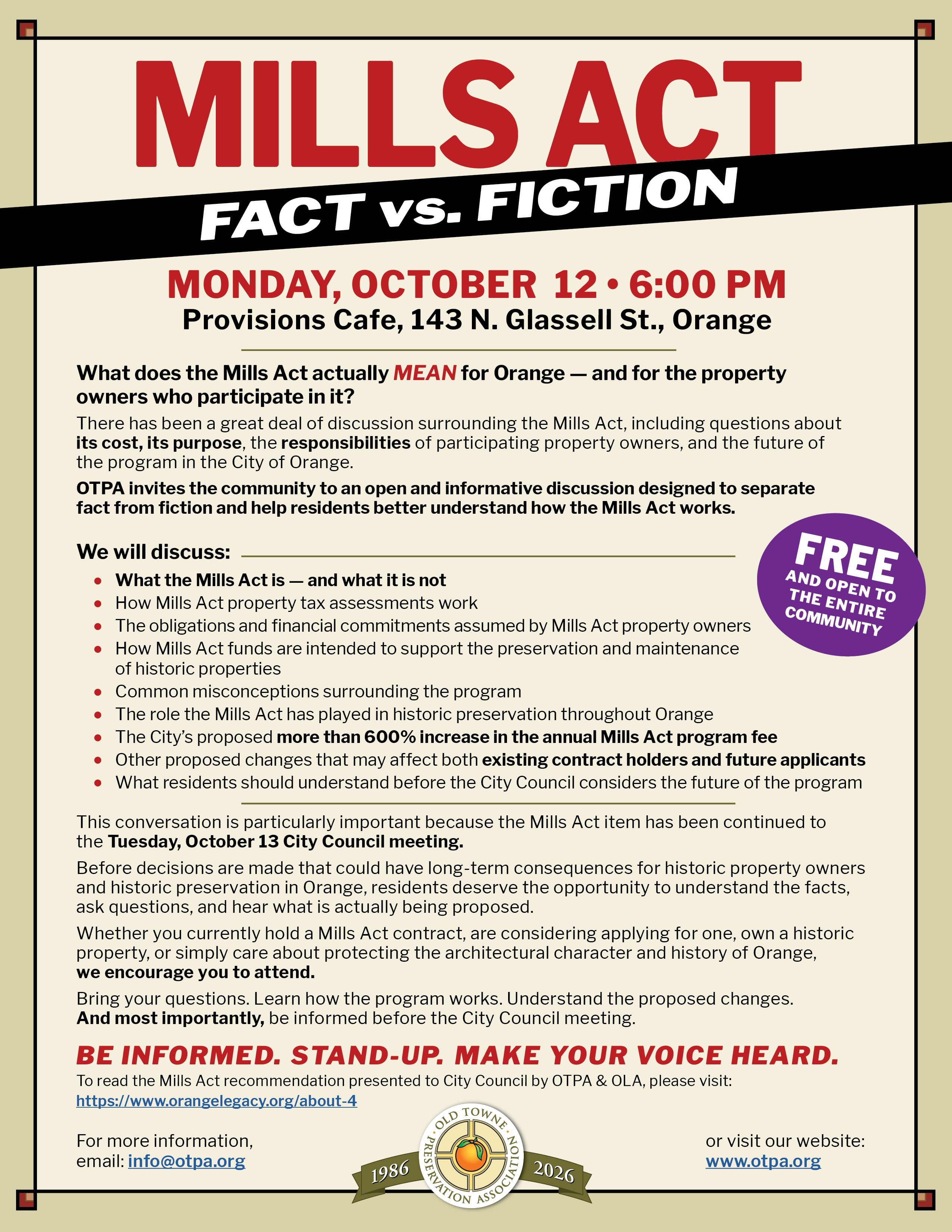
Presented by the Old Towne Preservation Association, Orange Legacy Alliance, Kelly Laule of Better Living SoCal, and Justin Ladd of Historic Homes OC
Free and open to the communityA series of community discussions to clear up misconceptions, answer questions and help residents understand the program. A panel discussion was held October 12 at Provisions Café in Old Towne. Additional discussions are being planned. Dates will be posted here. Check back regularly for more info.
Topics from the first discussion:
First discussion: Monday, October 12, 6pm, Provisions Cafe, 143 N. Glassell St., Orange. Questions: info@otpa.org.
The Mills Act lives in two parts of California law: Government Code sections 50280–50290, which set the contract rules, and Revenue and Taxation Code sections 439–439.4, which tell the County Assessor how to value the property.
The Assessor ignores sales prices. Instead, the value comes from the rent the home could earn, divided by a set rate (Rev. & Tax. Code 439.2):
The tax bill is based on the lowest of three numbers: the Mills Act value, the regular Prop. 13 value, or current market value. It is recalculated every year, and the home's Prop. 13 base year value doesn't change.
A 1909 owner-occupied house, 1,300 sq ft, with a Prop. 13 value of $572,220 and a market value of $625,000. Rent of $2,200 a month, less 5% vacancy and 25% expenses, gives $18,810 of net income. Divided by a 10.52% rate, the Mills Act value is $178,728, about 69% below its Prop. 13 value.
Illustration only, from the Orange County Assessor. Rates change every year and each property differs.
When a Mills Act home sells, the Assessor sets a new base year value but does not send a supplemental tax bill for the restricted property (State Board of Equalization Letter to Assessors 2005/035).
The City Council created Orange's program in 1998. Old Towne is the largest National Register historic district in California, so the program matters to a lot of homeowners.
Applications are on hold. The city has paused new Mills Act applications while it reviews the program. The draft Mills Act Program Guidelines were reviewed alongside the new historic preservation ordinance in August 2026, so the rules for new contracts are likely to change when the ordinance is adopted.
Existing contracts still apply. Current Mills Act owners in Orange pay an annual filing fee, file an annual report on repairs and maintenance, and update the rehabilitation plan (Exhibit D of the contract) every ten years.
Buying a Mills Act home? Ask for a copy of the recorded contract and the rehabilitation plan. The work obligations and the lower tax bill both transfer to you, and the tax bill you inherit may not match what the seller paid.
City of Orange Community Development, Historic Preservation
300 E. Chapman Ave., Orange, CA 92866
(714) 744-7220
Orange County Assessor, for a savings estimate
(714) 796-8048
Orange adopted the Mills Act as a pilot program in August 1998 (Resolution 8920). The city's stated goals were to:
The resolution also aimed to prevent inappropriate alterations and make sure each property's historic character was preserved and maintained in an exemplary manner.
Orange has protected Old Towne through a historic district zoning overlay and design standards, without a standalone historic preservation ordinance. The City wrote one with consultant Chattel, Inc., and City Council approved its first reading on November 10, 2026. It takes effect after a second reading.
Council narrows Design Review Committee review to historic properties and directs staff to finish a citywide ordinance with a consultant.
Joint Planning Commission and Design Review Committee session on the ordinance's scope.
Public workshop at the Orange Public Library to gather input.
Design Review Committee reviews the draft ordinance and the Mills Act Program Guidelines.
The revised draft, updated with Design Review Committee, Planning Commission, community and City Council comments, went to City Council for a first reading. The item was continued.
City Council approves the first reading of the Historic Preservation Ordinance, including the new Heritage Commission.
The ordinance returns to City Council for a second reading. If approved, it is formally adopted. Date to be confirmed.
Not yet. The city has paused new applications while it reviews the program. On 10/13/26 City Council continued the Mills Act item to April 13, 2027 so staff can review the proposed changes. Check back here for updates.
Generally no. The contract focuses on preserving the historic character of the property, mainly the exterior, and interior remodels are usually not covered. State law does require the city to inspect the interior and exterior every five years.
Yes. The contract is recorded against the property and binds each new owner, including the maintenance and rehabilitation commitments.
It varies with the property. The Assessor taxes the lowest of three values each year: the Prop. 13 value, the market value and the Mills Act value. In the Assessor's 2019 example, a 1909 home's taxable value fell from $572,220 to $178,728. Long-term owners whose Prop. 13 value is already low may save little or nothing. The Orange County Assessor can give you an estimate before you apply, and you can try the savings calculator.
The Assessor revalues every Mills Act property each year using current area rents and the state's capitalization rate, so small changes from year to year are normal, according to the California Office of Historic Preservation.
The state says local governments use it to rehabilitate whole neighborhoods, encourage seismic safety, support affordable housing, promote heritage tourism and foster pride of ownership. Reinvestment in older areas and a sense of continuity with the community's past are among the benefits cities cite.
August 1998, as a pilot program under Resolution 8920. The Council planned to review it after 12 months or 10 approved applicants. The original fees were $400 to apply and $35 a year for inspection and reporting (Resolution 8982). More on the program's history.
If the city finds a breach, it must hold a public hearing first. If the contract is canceled, the owner pays a fee of 12.5% of the property's current market value. Owners who simply want out can file a notice of nonrenewal instead, and the contract runs out over its remaining term of ten years.
No. State law lets a city charge the owner a fee, but the fee cannot exceed the reasonable cost of providing the service (Gov. Code 50281.1).
The Assessor sets a new base year value when the home sells, but the restricted historic property is not subject to a supplemental assessment (BOE Letter to Assessors 2005/035). Part of a parcel that isn't covered by the contract can still get one.
It could. The draft reaches historic properties on the city's inventory outside the districts, and properties that could qualify for historic status. Review the draft or ask the city how your address is treated.
Read the draft on the city's Community Development page, send comments to Community Development, and attend or speak at the second reading, tentatively Nov. 24 or Dec. 8 (TBD). City Council approved the first reading on 11/10/26.
Don’t see your question? Ask it here.
Ask about applying, savings, buying or selling a Mills Act home, an existing contract or the new ordinance. Your question goes to the team at Mills Act Orange, and they’ll email you back.
The team at Mills Act Orange will email you back.
Your question goes to the team at Mills Act Orange, and they’ll email you back. If you check the box, your question may also be answered below so others can learn from it. Names and addresses are never posted.
Answers are general information, not legal or tax advice. Official decisions come from the City of Orange and the County Assessor.
The Mills Act can be complicated. This website was created as an independent educational resource to provide clear, easy-to-understand information about the program and to answer many of the questions property owners and community members may have.
To keep the information straightforward and accessible, some topics have been summarized and may not include every detail, requirement, exception or circumstance that could apply. There is much more to the Mills Act than can be covered on these pages, and information will continue to be added and updated as additional questions and issues arise.
We encourage visitors who want to learn more to explore the source materials and additional resources provided throughout the site.
This website is a collaborative effort by individuals and organizations with an interest in historic preservation and the Mills Act. It is not affiliated with, operated by, or an official publication of the City of Orange.
Hi! Do you have questions about the Mills Act or Orange's new Historic Preservation Ordinance? I can help.